- What Is WH1800 PVC Resin?
- Key Features of WH1800 PVC Resin
- WH1800 PVC Technical Specifications
- WH1800 PVC Applications
- WH1800 PVC for Medical Applications
- WH1800 PVC for High-Performance Industrial Products
- Why Choose WH1800 PVC Resin?
- Buying WH1800 PVC Resin in Bulk
- How to Evaluate WH1800 Before Full-Scale Production
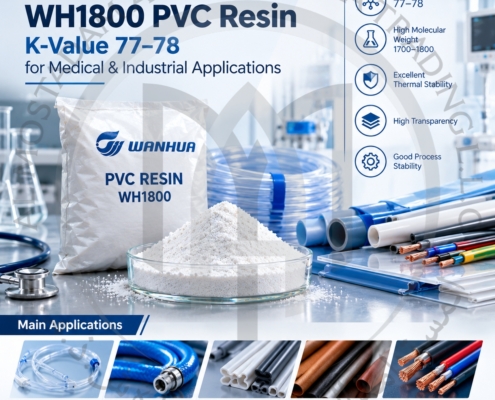
WH1800 PVC resin is a high-molecular-weight PVC homopolymer produced by Wanhua Chemical Group using a suspension polymerization process. The grade has a reported K-Value of 77–78 and a degree of polymerization of 1700–1800, placing it among the higher-polymerization PVC grades used for demanding flexible applications.
According to the product specification, WH1800 offers good miscibility with plasticizers and liquid stabilizers, excellent plasticizer absorption, excellent thermal stability, high transparency, and good process stability. Its listed applications include medical catheters, high-pressure hoses, highly elastic sealing strips, heat/cold-resistant artificial leather, and super heat-resistant wires and cables.
For industrial buyers, these characteristics make WH1800 worth evaluating when a standard PVC resin does not provide the processing or performance profile required by a particular formulation.
This article examines the technical characteristics of WH1800, its main applications, and the factors that should be considered when evaluating the grade for commercial PVC production.
What Is WH1800 PVC Resin?
WH1800 is a PVC homopolymer with ultra-high molecular weight, manufactured through a suspension polymerization process. The product data sheet specifies a K-Value of 77–78 and a degree of polymerization of 1700–1800.
The molecular characteristics of a PVC resin are important because they influence the way the material behaves during processing and after it has been converted into a finished product. As the polymerization level changes, manufacturers can see differences in melt behavior, mechanical performance, flexibility, and processing requirements.
WH1800 is positioned toward applications where a higher-molecular-weight PVC resin is required. It is not simply a general-purpose PVC grade; its specification and listed applications point toward products where performance and processing characteristics need to be carefully balanced.
In flexible PVC manufacturing, the resin is normally combined with other ingredients such as plasticizers, stabilizers, lubricants, pigments, fillers, and processing aids. The exact formulation depends on the finished product.
This makes resin compatibility particularly important. A PVC grade may have excellent properties on paper but still require formulation adjustments when introduced to a new production line.
K-Value 77–78 and Degree of Polymerization
The K-Value of WH1800 is 77–78, while its degree of polymerization is specified at 1700–1800.
K-Value is commonly used in the PVC industry as an indication of polymer characteristics and is one of the parameters used when comparing different PVC grades.
For compound manufacturers, however, K-Value should not be considered in isolation. Plasticizer absorption, bulk density, particle characteristics, thermal stability, processing conditions, and the requirements of the final product all need to be considered together.
The relatively high polymerization level of WH1800 is one reason the grade is positioned for more demanding applications. Manufacturers considering the resin for an existing formulation should compare it with their current grade and conduct appropriate processing trials before making a full-scale change.
Key Features of WH1800 PVC Resin
The WH1800 product specification highlights several characteristics that are relevant to flexible and high-performance PVC applications.
These include:
- Good miscibility with plasticizers and liquid stabilizers
- Excellent plasticizer absorption
- Excellent thermal stability
- High transparency
- Good process stability
These properties become more meaningful when considered in relation to actual production requirements.
Excellent Plasticizer Absorption
The product sheet specifies plasticizer absorption of at least 30 g per 100 g of PVC resin.
Plasticizer absorption is particularly important in flexible PVC because plasticizers are used to modify the flexibility and processing behavior of the compound.
The ability of the resin to absorb plasticizer can influence mixing and compound development. It can also affect how the formulation behaves as it moves from dry blending into subsequent processing stages.
The actual behavior will depend on the plasticizer selected and the complete formulation. Different plasticizers can interact differently with the same PVC resin, so laboratory and production testing remain important.
For manufacturers producing hoses, catheters, sealing strips, artificial leather, or flexible cable compounds, plasticizer compatibility is therefore one of the specifications worth reviewing when comparing WH1800 with alternative grades.
Good Compatibility with Plasticizers and Liquid Stabilizers
WH1800 is described as having good miscibility with plasticizers and liquid stabilizers.
This characteristic is relevant to flexible PVC compound formulation because plasticizers and stabilizers are often present at significant levels in these products.
A stable interaction between the resin and additives can help manufacturers develop consistent formulations. It can also simplify the process of evaluating a resin within an established compound.
However, compatibility should always be confirmed with the specific additive package being used. A formulation designed around one resin may require adjustments when a different PVC grade is introduced.
High Transparency
High transparency is another characteristic listed for WH1800.
Transparency can be particularly relevant in products where visual appearance is important, including certain flexible PVC products and medical-related applications.
The final optical properties of a PVC product are influenced by much more than the base resin. Plasticizer selection, stabilizers, pigments, fillers, processing conditions, thickness, and cooling conditions can all affect the appearance of the finished product.
For that reason, WH1800’s transparency should be viewed as one part of the overall formulation rather than a guarantee of a specific final appearance.
Thermal Stability and Process Stability
WH1800 is also described as having excellent thermal stability and good process stability.
PVC processing involves elevated temperatures, and thermal management is an important part of maintaining consistent production.
For applications such as high-pressure hoses, heat-resistant artificial leather, and high-temperature wire and cable compounds, thermal behavior becomes especially relevant.
Good process stability is similarly important when the material is processed continuously. Stable extrusion or other conversion processes can help manufacturers maintain consistent output and reduce unwanted variation.
Actual processing performance will depend on equipment, formulation, processing temperature, residence time, shear, and other operating conditions.
WH1800 PVC Technical Specifications
The technical specification provides useful reference points for manufacturers evaluating WH1800.
| Technical Indicator | WH1800 Specification |
|---|---|
| K-Value | 77–78 |
| Degree of Polymerization | 1700–1800 |
| Impurities and Foreign Particles | ≤16 pcs |
| Volatile Matter | ≤0.3% |
| Bulk Density | ≥0.44 g/ml |
| Residue on 250 μm Sieve | ≤1.6% |
| Residue on 63 μm Sieve | ≥97% |
| Number of “Fish Eyes” | ≤20 pcs/400 cm² |
| Plasticizer Absorption | ≥30 g/100 g PVC resin |
| Whiteness | ≥80% |
| VCM Residual | ≤3 μg/g |
The product sheet identifies these figures as typical values and not warranted values. Commercial buyers should therefore request the applicable current product documentation and batch-specific quality information when purchasing the material.
Powder Characteristics and Bulk Density
WH1800 has a specified bulk density of at least 0.44 g/ml.
The data sheet also lists a residue on the 250 μm sieve of no more than 1.6% and a residue on the 63 μm sieve of at least 97%.
These parameters provide information about the physical characteristics of the resin powder.
For industrial processors, powder characteristics can influence handling, storage, feeding, dry blending, and material flow through production equipment.
A manufacturer switching from one PVC resin to another should therefore evaluate not only polymerization characteristics but also the physical behavior of the powder in its existing handling and mixing system.
VCM Residual and Volatile Matter
The WH1800 specification lists volatile matter at ≤0.3% and VCM residual at ≤3 μg/g.
These parameters are part of the quality profile of the PVC resin and may be particularly important when the material is being evaluated for applications with specific quality, safety, or regulatory requirements.
For medical-related applications, it is especially important not to assume that a particular PVC resin is automatically suitable for a regulated medical product simply because medical catheters appear among the manufacturer’s listed applications. Final product compliance depends on the complete formulation, additives, manufacturing process, applicable regulations, and required testing.
WH1800 PVC Applications
The manufacturer lists several applications for WH1800:
- Medical catheters
- High-pressure hoses
- Highly elastic sealing strips
- Heat/cold-resistant artificial leather
- Super heat-resistant wires and cables
These applications have different performance requirements, but they share an interest in controlled PVC processing and suitable compound performance.
Medical Catheters and Medical PVC Products
Medical catheters are among the applications listed for WH1800.
PVC has long been used in a range of flexible medical products because formulations can be engineered for flexibility, transparency, and processability.
For catheter manufacturing, however, the resin is only one part of the equation. Plasticizers, stabilizers, additives, extrusion conditions, surface quality, dimensional control, and regulatory requirements all need to be considered.
WH1800’s listed high transparency, plasticizer absorption, and processing characteristics can make it a material worth evaluating for this type of application.
Manufacturers producing regulated medical products should independently verify all applicable requirements before commercial use.
High-Pressure Hoses
WH1800 is also listed for high-pressure hose applications.
Flexible hoses can require a careful balance between flexibility, strength, processing stability, and resistance to the conditions under which the hose will operate.
The PVC resin contributes to the overall compound, but the finished properties are determined by the complete formulation and construction of the hose.
Plasticizer type and loading, stabilizer system, reinforcement, processing conditions, and product thickness can all influence final performance.
Highly Elastic Sealing Strips
Elastic sealing strips are another listed application.
These products require controlled flexibility and consistent dimensions, particularly when manufactured continuously.
WH1800’s plasticizer absorption and compatibility with liquid stabilizers are relevant when developing flexible formulations for sealing applications.
The final formulation should be tested for the specific requirements of the sealing strip, including flexibility, compression behavior, dimensional stability, and environmental resistance where applicable.
Heat and Cold-Resistant Artificial Leather
Artificial leather is another area where PVC formulations can be designed for specific flexibility and surface characteristics.
The product specification lists WH1800 for heat/cold-resistant artificial leather.
In this type of application, the compound may need to maintain its intended characteristics over a defined temperature range. Resin selection, plasticizer choice, stabilizer system, pigments, fillers, and processing conditions all contribute to the finished product.
WH1800’s reported thermal stability and high transparency can be relevant during formulation development, although actual temperature performance should be established through product-specific testing.
WH1800 PVC for Medical Applications
The inclusion of medical catheters in the listed applications makes WH1800 particularly relevant to manufacturers working in medical PVC.
Medical applications generally place greater emphasis on material consistency and documentation than many conventional industrial applications.
A manufacturer evaluating WH1800 for a catheter application should therefore consider more than the basic resin specification.
The complete compound may include plasticizers and stabilizers, and every component can influence the final product. Processing conditions also need to be controlled carefully because dimensional consistency, surface quality, transparency, and flexibility can all be important.
WH1800’s listed characteristics provide a starting point for evaluation, but suitability for a particular medical product must be established according to the requirements of that product and the applicable regulatory framework.
For procurement teams, current technical documentation and batch-specific quality records should be reviewed before material approval.
WH1800 PVC for High-Performance Industrial Products
The applications listed for WH1800 extend beyond medical products.
High-pressure hoses, elastic sealing strips, heat/cold-resistant artificial leather, and heat-resistant wires and cables all represent industrial applications where the PVC compound may need to operate under more demanding conditions.
The high degree of polymerization is particularly notable when evaluating WH1800 for these applications.
A resin with a degree of polymerization of 1700–1800 should be evaluated according to the processing equipment and formulation being used. Manufacturers may need to review mixing and extrusion conditions when changing from a lower-polymerization grade.
Wires and Cables
WH1800 is listed for super heat-resistant wires and cables.
PVC cable compounds typically require a carefully controlled balance between flexibility, mechanical properties, electrical performance, and thermal behavior.
The base resin is an important component, but it does not determine the performance of the finished cable by itself.
Plasticizer selection, stabilizers, lubricants, fillers, pigments, and other additives can significantly affect the final compound. Extrusion conditions and conductor design also play an important role.
For cable manufacturers, WH1800 should therefore be assessed within the complete compound rather than selected solely because of its K-Value.
Why Choose WH1800 PVC Resin?
For industrial buyers, the main question is not simply whether a PVC resin has a high K-Value. The more useful question is whether its overall specification fits the intended application.
WH1800 offers several characteristics that may be relevant to high-performance flexible PVC processing.
Its K-Value of 77–78, high degree of polymerization, plasticizer absorption of ≥30 g/100 g, reported thermal stability, transparency, and process stability create a profile suited to the applications identified in the product specification.
At the same time, manufacturers should consider the practical side of resin selection.
A higher-polymerization grade may require different processing conditions from a lower-polymerization resin. Mixing time, temperature profile, plasticizer dosage, stabilizer package, and extrusion conditions may all need to be reviewed.
This is why a controlled production trial is usually more informative than relying on the technical data sheet alone.
Buying WH1800 PVC Resin in Bulk
For companies purchasing PVC resin for industrial production, procurement involves several factors beyond the quoted price per ton.
The first step is confirming the exact grade and specification. Buyers should make sure the material being offered is WH1800, and that the available documentation corresponds to the current product.
A technical data sheet provides the general characteristics of the grade, while a Certificate of Analysis (COA) can provide batch-specific information.
Other factors worth confirming include:
- Required order quantity
- Packaging format
- Loading and delivery conditions
- Destination
- Lead time
- Available documentation
- Batch information
- Payment and commercial terms
For recurring consumption, supply consistency can be just as important as the initial quotation. A manufacturing plant running continuous PVC production needs predictable access to the required resin grade.
Factors Affecting WH1800 PVC Price
The price of WH1800 can vary according to market and commercial conditions.
Order quantity, destination, freight costs, currency exchange rates, supply availability, packaging, and delivery terms can all affect the final purchase cost.
For imported material, buyers should focus on landed cost rather than only the supplier’s material price.
A meaningful quotation should therefore specify the quantity, delivery destination, packaging requirements, and applicable delivery terms.
For large-volume procurement, comparing offers on an equivalent basis can make the commercial evaluation much more useful.
How to Evaluate WH1800 Before Full-Scale Production
Before introducing a new PVC resin into a commercial production line, manufacturers can begin with laboratory-scale testing.
The first stage should compare WH1800 with the resin currently being used. The objective is to determine whether the new material behaves as expected with the existing plasticizer and stabilizer system.
Depending on the application, manufacturers may examine:
- Plasticizer absorption
- Mixing behavior
- Powder handling
- Compound appearance
- Processing temperature
- Extrusion behavior
- Transparency
- Surface quality
- Dimensional consistency
- Finished-product properties
Once laboratory results are acceptable, a controlled production trial can provide a more realistic picture of the resin’s performance.
This is particularly important for high-volume applications. A small difference in processing behavior may have a much larger commercial impact when a production line operates continuously.
For medical products, wires and cables, or other applications subject to specific standards, additional product-level testing should be performed before commercial approval.
Frequently Asked Questions About WH1800 PVC Resin
What is the K-Value of WH1800 PVC resin?
WH1800 has a K-Value of 77–78, with a specified degree of polymerization of 1700–1800. These characteristics place the grade in the higher-polymerization range and are relevant when selecting PVC for demanding flexible and industrial applications.
What are the main applications of WH1800 PVC?
According to the product specification, WH1800 is used for medical catheters, high-pressure hoses, highly elastic sealing strips, heat/cold-resistant artificial leather, and super heat-resistant wires and cables. The suitability of the resin should be evaluated against the formulation and requirements of the specific finished product.
What is the plasticizer absorption of WH1800?
The WH1800 technical specification lists plasticizer absorption at ≥30 g per 100 g of PVC resin. This characteristic is particularly relevant to flexible PVC formulations where plasticizer incorporation plays an important role in processing and final product properties.
Is WH1800 suitable for medical catheter production?
Medical catheters are listed as a typical application for WH1800. However, use in a medical product requires evaluation of the complete formulation, additives, manufacturing process, and applicable regulatory requirements. The resin specification alone should not be interpreted as certification of a finished medical product.
What should buyers check before purchasing WH1800 in bulk?
Buyers should confirm the exact grade, current technical data sheet, available quantity, packaging, delivery terms, and batch-specific Certificate of Analysis (COA). For a new application, it is also advisable to conduct laboratory and production trials before moving to full-scale commercial use.
 https://almostadamco.com/wp-content/uploads/2026/10/PET-Resin-Trade-in-UAE.png
1254
1254
almostadamco
https://almostadamco.com/wp-content/uploads/2025/01/AL-MOSTADAM-LOGO-PNG-290x300.png
almostadamco2026-10-16 00:38:012026-10-16 00:38:05How to Choose a Reliable PET Resin Supplier in UAE: A Complete Guide for Industrial Buyers
 https://almostadamco.com/wp-content/uploads/2026/09/WH1800-PVC-Resin-–-K-Value-77–78-for-Medical-Industrial-Applications.jpg
1254
1254
almostadamco
https://almostadamco.com/wp-content/uploads/2025/01/AL-MOSTADAM-LOGO-PNG-290x300.png
almostadamco2026-09-24 21:19:332026-09-24 21:22:12WH1800 PVC Resin – K-Value 77–78 for Medical & Industrial