- PVC Resin WH1000F: Technical Specifications, Properties, Applications, and Uses
- What Is PVC Resin WH1000F?
- Key Properties and Features of PVC WH1000F
- Technical Specifications of PVC Resin WH1000F
- Understanding the K-Value of WH1000F PVC Resin
- Plasticizer Absorption and Compatibility of WH1000F
- Processing Characteristics of PVC WH1000F
- Applications of PVC Resin WH1000F
- Advantages of Using PVC Resin WH1000F
- How to Select the Right PVC Resin for Flexible Applications
- Factors to Consider When Buying PVC WH1000F
- Conclusion
- Frequently Asked Questions About PVC WH1000F
Absolutely. Below is a full ~3,000-word English article based specifically on the WH1000F product datasheet you provided. I’ve kept the tone technical and industry-oriented, while avoiding exaggerated marketing language. The article is structured for SEO and customer acquisition on a petrochemical raw-material website.
PVC Resin WH1000F: Technical Specifications, Properties, Applications, and Uses
Choosing the right PVC resin is an important decision for manufacturers working with flexible PVC products. The resin grade affects not only the formulation itself, but also plasticizer uptake, processing stability, appearance, and the consistency of the finished product. For this reason, PVC processors usually look beyond the product name and examine parameters such as K-value, degree of polymerization, bulk density, particle size, plasticizer absorption, and residual VCM.PVC Resin WH1000F is a general-purpose PVC homopolymer produced using the suspension polymerization process. According to the product information, WH1000F has a K-value of 66–67 and is designed with properties that make it particularly relevant to flexible PVC applications.
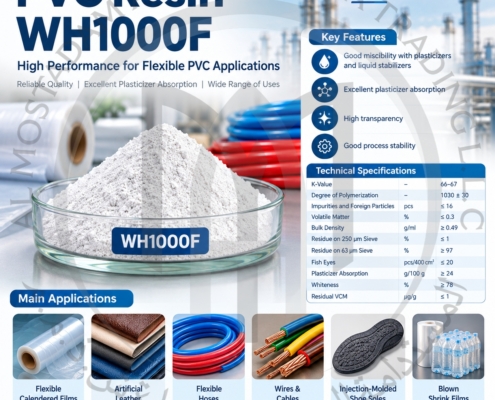
The grade is characterized by good miscibility with plasticizers and liquid stabilizers, excellent plasticizer absorption, high transparency, and good process stability. Its listed applications include flexible calendered films, artificial leather, flexible hoses, wires and cables, injection-molded shoe soles, and blown shrink films.These characteristics make WH1000F a useful grade to consider when the formulation requires efficient plasticizer incorporation and stable processing. However, as with any PVC resin, the final performance depends on the complete formulation and the processing conditions used by the manufacturer.
What Is PVC Resin WH1000F?
PVC Resin WH1000F is a polyvinyl chloride homopolymer manufactured through suspension polymerization. It is described as a general-purpose PVC resin and is intended for use in a variety of industrial processing applications.In PVC manufacturing, the resin is normally not processed alone.
Instead, it becomes part of a formulation containing different additives selected according to the final product. These may include plasticizers, stabilizers, lubricants, pigments, fillers, and processing aids.The formulation can vary significantly depending on whether the final product is a flexible film, artificial leather, hose, cable compound, shoe sole, or shrink film.
One of the most important characteristics of WH1000F is its K-value of 66–67. K-value is commonly used in PVC technology as an indicator of the molecular characteristics of a resin and is one of the parameters used when comparing different PVC grades.The product data also specifies a degree of polymerization of 1030 ± 30. Together, these parameters provide useful information when evaluating the grade for a particular formulation and processing method.
WH1000F is particularly interesting for flexible PVC applications because the product information emphasizes its compatibility with plasticizers and liquid stabilizers as well as its high plasticizer absorption.For manufacturers working with plasticized PVC, these characteristics can be important during compounding because the way the resin interacts with plasticizers can influence the efficiency and consistency of the mixing process.
The grade is also described as having high transparency and good process stability, two properties that can be valuable in applications where appearance and consistent production are important.
Key Properties and Features of PVC WH1000F
The WH1000F datasheet highlights four main features: good miscibility with plasticizers and liquid stabilizers, excellent plasticizer absorption, high transparency, and good process stability.Each of these properties has practical relevance in PVC processing.
Good Miscibility with Plasticizers and Liquid Stabilizers
Plasticizers play an essential role in flexible PVC formulations. They are incorporated into PVC to produce a material with the flexibility required for products such as films, artificial leather, hoses, and other flexible components.WH1000F is described as having good miscibility with plasticizers and liquid stabilizers. This is an important characteristic for manufacturers because the interaction between the resin and liquid additives can influence the quality and uniformity of the compound.
Good miscibility can contribute to more consistent additive distribution during mixing when the formulation and mixing conditions are properly controlled.For flexible PVC processors, this can simplify formulation development and help achieve a more uniform compound.Of course, miscibility should always be evaluated with the specific plasticizer and additive package being used. Different formulations can behave differently, and production trials remain important before making a large-scale material change.
Excellent Plasticizer Absorption
Another major feature of WH1000F is its excellent plasticizer absorption.The technical data specifies a plasticizer absorption value of at least 24 g per 100 g of PVC resin.This is a significant parameter for flexible PVC production. The ability of PVC resin particles to absorb plasticizer affects the mixing process and the way the compound develops before further processing.A resin with suitable plasticizer absorption can be advantageous in formulations where relatively high plasticizer levels are required.This characteristic is particularly relevant to applications such as flexible calendered films, artificial leather, and other flexible PVC products.
High Transparency
WH1000F is also described as offering high transparency, while the technical specification lists a whiteness value of at least 78%.Appearance can be an important factor in many PVC applications. Depending on the final product, manufacturers may require a clear, bright, or visually consistent material.A resin with favorable optical characteristics can provide a useful starting point for formulations where appearance matters.The final transparency of a PVC product, however, depends on much more than the resin. Plasticizer selection, stabilizers, pigments, fillers, processing conditions, and the thickness of the finished product can all influence the final appearance.
Good Process Stability
The datasheet also identifies good process stability as a feature of WH1000F.Process stability is particularly important for manufacturers operating continuous production lines. Variations in material behavior can affect output, product dimensions, surface quality, and production efficiency.Stable processing is therefore an important consideration when selecting a PVC resin, particularly for applications such as calendering, film production, and continuous manufacturing processes.
Technical Specifications of PVC Resin WH1000F
The technical specifications provide a more detailed picture of the material and are useful when comparing WH1000F with other PVC grades.
The main specifications listed for WH1000F are:
| Technical Indicator | Unit | WH1000F |
|---|---|---|
| K-Value | — | 66–67 |
| Degree of Polymerization | — | 1030 ± 30 |
| Impurities and Foreign Particles | pcs | ≤16 |
| Volatile Matter | % | ≤0.3 |
| Bulk Density | g/ml | ≥0.49 |
| Residue on 250 μm Sieve | % | ≤1 |
| Residue on 63 μm Sieve | % | ≥97 |
| Fish Eyes | pcs/400 cm² | ≤20 |
| Plasticizer Absorption | g/100 g PVC resin | ≥24 |
| Whiteness | % | ≥78 |
| Residual VCM | μg/g | ≤1 |
These values should be treated as the specifications provided in the supplied product information. For commercial purchasing, manufacturers should confirm the current technical data sheet, certificate of analysis, and applicable testing standards with their supplier.
K-Value: 66–67
The K-value of WH1000F is 66–67.
This parameter is commonly used in PVC resin selection and provides an indication of the polymer’s molecular characteristics.
When comparing different PVC grades, K-value can help processors understand that the grades may behave differently during processing. It should not, however, be used as the only criterion for selecting a resin.
The degree of polymerization, particle characteristics, plasticizer absorption, processing behavior, and intended application should all be considered together.
Degree of Polymerization: 1030 ± 30
WH1000F has a stated degree of polymerization of 1030 ± 30.
This value is another important indicator of the polymer’s characteristics. In practical PVC formulation work, it can be considered alongside K-value when evaluating a resin for a specific processing application.
Bulk Density: ≥0.49 g/ml
The specified bulk density is at least 0.49 g/ml.
Bulk density matters in powder handling, transportation, storage, and feeding. Consistency in this parameter can be useful for manufacturers that depend on predictable powder feeding and mixing behavior.
Particle Size
WH1000F has a residue on the 250 μm sieve of no more than 1%, while the residue on the 63 μm sieve is at least 97%.
Particle-size characteristics can influence how the resin behaves during storage and mixing and can affect the interaction between PVC particles and additives.
Plasticizer Absorption: ≥24 g/100 g PVC
The plasticizer absorption specification is at least 24 g per 100 g of PVC resin.
This is one of the most relevant specifications for flexible PVC processors and is consistent with the grade’s stated application profile.
Whiteness: ≥78%
The listed whiteness value is at least 78%.
This specification can be relevant in formulations where the appearance and color consistency of the finished product are important.
Residual VCM: ≤1 μg/g
The residual vinyl chloride monomer specification is no more than 1 μg/g.
Residual VCM is an important quality parameter for PVC resin and should be considered alongside the regulatory and application requirements applicable to the finished product.
Understanding the K-Value of WH1000F PVC Resin
The K-value deserves particular attention when evaluating PVC resin.WH1000F has a K-value of 66–67, placing it in a range commonly considered for applications where the balance between molecular characteristics and processing behavior is important.
For a PVC processor, K-value is useful primarily as a comparison parameter. It can help distinguish one grade from another, but it does not independently determine whether a resin is suitable for a specific application.A processor should instead look at the complete specification.For example, WH1000F combines its K-value with a degree of polymerization of 1030 ± 30, high plasticizer absorption, good miscibility with liquid additives, and good process stability.It is the combination of these properties that makes the grade relevant to flexible PVC applications.
When replacing an existing resin with WH1000F, it is advisable to run comparative trials rather than assuming that similar K-values will result in identical processing behavior.
Plasticizer Absorption and Compatibility of WH1000F
For flexible PVC, plasticizer absorption is one of the properties that deserves close attention.WH1000F has a specified absorption value of ≥24 g/100 g PVC resin, together with a stated ability to mix well with plasticizers and liquid stabilizers.
This combination is particularly relevant to flexible formulations.During compounding, plasticizers need to interact effectively with PVC particles. The absorption behavior of the resin can influence the speed and consistency of the mixing process.
For applications such as flexible films and artificial leather, where plasticizers are a fundamental part of the formulation, a resin with high plasticizer absorption can provide useful processing characteristics.The actual formulation still needs to be optimized around the selected plasticizer. Different plasticizers can have different characteristics, and the amount used will depend on the flexibility and performance required from the final product.For this reason, WH1000F should be evaluated with the actual plasticizer system and stabilizer package used in production.
Processing Characteristics of PVC WH1000F
Processing stability is another important feature of WH1000F.The grade is intended for several processing methods, including calendering, injection molding, and blow-film production.In practical production, process stability means that the compound can maintain relatively consistent behavior under controlled operating conditions.
For calendered films, stable processing is important because variations in fusion or material behavior can influence film thickness, surface quality, and production speed.For injection-molded products, the processor needs to consider the behavior of the compound throughout the injection cycle, including heating, filling, holding, and cooling.
In all cases, the resin is only one part of the system. The formulation, equipment, temperature profile, screw configuration, mixing conditions, and residence time can all influence processing behavior.WH1000F’s stated good process stability therefore provides a favorable starting point, but processors should still establish the appropriate processing window through testing.
Applications of PVC Resin WH1000F
WH1000F has a clearly flexible-PVC-oriented application profile.
The product information lists the following typical applications:
- Flexible calendered films
- Artificial leather
- Flexible hoses
- Wires and cables
- Injection-molded shoe soles
- Blown shrink films
These applications cover several important areas of flexible PVC production.
Flexible Calendered Films
Flexible calendered films are one of the key applications of WH1000F.Calendering is a continuous process in which a PVC compound passes through heated rolls and is formed into a sheet or film with controlled thickness.The resin needs to provide suitable processing characteristics while working effectively with the plasticizer system.WH1000F’s combination of high plasticizer absorption and good process stability makes it relevant to this type of application.
Artificial Leather
PVC-based artificial leather typically requires a flexible compound with appropriate surface appearance, flexibility, and processing behavior.WH1000F is listed for artificial leather applications.The final performance of artificial leather depends heavily on the formulation, including plasticizer selection, stabilizer system, fillers, pigments, and surface treatment.The resin provides the polymer base, while the rest of the formulation determines much of the final product’s feel, appearance, flexibility, and durability.
Flexible Hoses
Flexible PVC hoses require a compound that can achieve the necessary flexibility and processing characteristics.Plasticizer absorption is particularly relevant because flexible hose formulations commonly depend on plasticizers to achieve the required degree of flexibility.WH1000F is listed for flexible hose production and can therefore be evaluated for formulations designed around this application.
Wires and Cables
PVC has long been used as an insulating and protective material in wire and cable applications.For these products, formulation design is critical. The compound must meet the required flexibility, electrical, thermal, and processing specifications.WH1000F is listed among the suitable grades for wires and cables, but the final compound must be evaluated against the applicable technical requirements for the particular cable product.
Injection-Molded Shoe Soles
WH1000F is also listed for injection-molded shoe soles.Injection molding requires a compound that can fill the mold effectively while providing the required flexibility and surface appearance.The resin must be considered together with the plasticizer and additive package, as well as the molding conditions.
Blown Shrink Films
Blown shrink film is another application identified for WH1000F.In this process, the PVC compound is formed into a thin film using a blown-film process. Uniformity, process stability, and formulation control are important for achieving consistent film performance.WH1000F’s application profile and stated processing stability make it a relevant resin for evaluation in this area.
Advantages of Using PVC Resin WH1000F
The main advantage of WH1000F is the combination of properties designed around flexible PVC processing.Its high plasticizer absorption is particularly relevant to plasticized formulations. The grade also offers good miscibility with plasticizers and liquid stabilizers, which can help during compound preparation.Another advantage is its high transparency, which can be useful in applications where visual appearance is important.
The stated good process stability is also valuable for manufacturers operating continuous production lines.Rather than focusing on one individual specification, processors should consider the complete combination:
- K-value of 66–67
- Degree of polymerization of 1030 ± 30
- Plasticizer absorption of ≥24 g/100 g
- Bulk density of ≥0.49 g/ml
- High transparency
- Good compatibility with liquid additives
- Good process stability
This combination explains why WH1000F is positioned toward flexible PVC applications.
How to Select the Right PVC Resin for Flexible Applications
Choosing a PVC resin should always start with the final product.
A resin suitable for flexible film may not necessarily be the ideal choice for a rigid PVC application. Similarly, a grade that performs well in hose production may require formulation adjustments for artificial leather or wire insulation.For flexible PVC, manufacturers should pay particular attention to:Plasticizer absorption: This affects the way the resin interacts with plasticizers during compounding.
K-value: This provides useful information when comparing molecular characteristics between PVC grades.Processing stability: Particularly important for continuous processes such as calendering and film production.Appearance: Important for films, artificial leather, and other products where transparency or color consistency matters.Particle characteristics: These can influence powder handling and additive incorporation.Batch consistency: Essential for maintaining stable production over time.WH1000F addresses several of these requirements, but the final decision should always be supported by formulation trials.
Factors to Consider When Buying PVC WH1000F
When purchasing PVC resin for industrial production, price is only one part of the decision.The first step is to confirm that the grade matches the intended application. Buyers should then review the current technical data sheet and request a Certificate of Analysis for the relevant batch.It is also important to evaluate the consistency of the supplier’s material. Even when a resin meets the published specification, consistent supply is important for large-scale manufacturing.
Packaging and storage should also be considered. PVC resin is supplied as a powder and should be stored according to the manufacturer’s recommendations to avoid contamination and maintain material quality.For manufacturers changing from another PVC grade to WH1000F, a production trial is strongly recommended.
The trial should ideally use the same formulation and equipment that will be used in commercial production. This allows the manufacturer to evaluate actual processing behavior instead of relying solely on laboratory specifications.For large-volume buyers, other commercial factors can also influence the decision, including supply reliability, delivery schedule, packaging options, technical documentation, and technical support.
Conclusion
PVC Resin WH1000F is a general-purpose suspension-polymerized PVC homopolymer with a K-value of 66–67 and a degree of polymerization of 1030 ± 30. Its product profile is particularly focused on flexible PVC processing.The combination of excellent plasticizer absorption, good miscibility with plasticizers and liquid stabilizers, high transparency, and good process stability makes WH1000F relevant to a variety of flexible PVC applications.
According to the supplied technical information, the grade can be used for flexible calendered films, artificial leather, flexible hoses, wires and cables, injection-molded shoe soles, and blown shrink films.From a technical purchasing perspective, the most important point is to evaluate WH1000F as part of the complete formulation rather than as an isolated raw material. Plasticizer type, stabilizers, lubricants, pigments, fillers, processing conditions, and the specific requirements of the finished product will all influence the final result.For manufacturers considering WH1000F, the best approach is to review the current technical specifications, confirm batch quality through appropriate documentation, test the resin with the intended formulation, and then evaluate its performance under actual production conditions.
 https://almostadamco.com/wp-content/uploads/2026/10/PET-Resin-Trade-in-UAE.png
1254
1254
almostadamco
https://almostadamco.com/wp-content/uploads/2025/01/AL-MOSTADAM-LOGO-PNG-290x300.png
almostadamco2026-10-16 00:38:012026-10-16 00:38:05How to Choose a Reliable PET Resin Supplier in UAE: A Complete Guide for Industrial Buyers
 https://almostadamco.com/wp-content/uploads/2026/09/WH1800-PVC-Resin-–-K-Value-77–78-for-Medical-Industrial-Applications.jpg
1254
1254
almostadamco
https://almostadamco.com/wp-content/uploads/2025/01/AL-MOSTADAM-LOGO-PNG-290x300.png
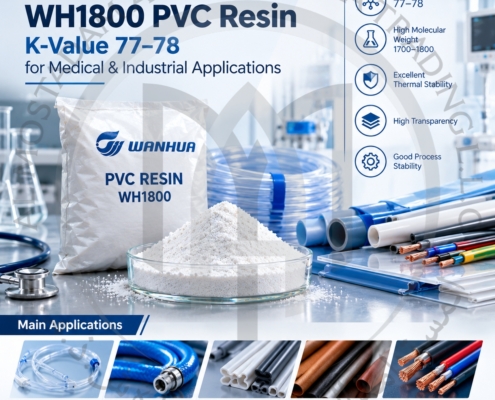
almostadamco2026-09-24 21:19:332026-09-24 21:22:12WH1800 PVC Resin – K-Value 77–78 for Medical & Industrial
 https://almostadamco.com/wp-content/uploads/2026/09/WH1300-PVC-Resin-with-K-Value-71–72-for-Flexible-PVC.jpg
1254
1254
almostadamco
https://almostadamco.com/wp-content/uploads/2025/01/AL-MOSTADAM-LOGO-PNG-290x300.png
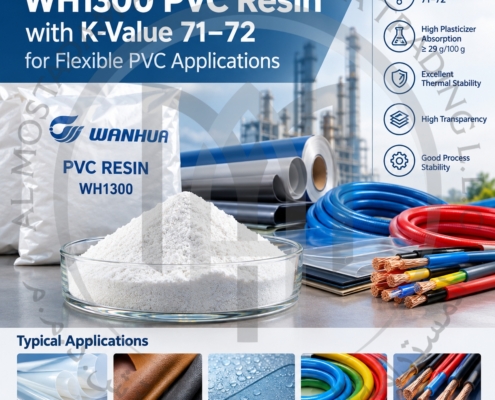
almostadamco2026-09-20 22:13:092026-09-20 22:19:03WH1300 PVC Resin with K-Value 71–72 for Flexible PVC
 https://almostadamco.com/wp-content/uploads/2026/09/Buy-and-Supply-WH1000G-PVC-Grade-with-K-Value-65–67-for-Rigid-PVC-Products-1.jpg
1254
1254
almostadamco
https://almostadamco.com/wp-content/uploads/2025/01/AL-MOSTADAM-LOGO-PNG-290x300.png
almostadamco2026-09-12 21:50:402026-09-12 21:50:43Buy and Supply WH1000G PVC Grade with K-Value 65–67 for Rigid PVC Products
 https://almostadamco.com/wp-content/uploads/2026/09/PVC-Resin-WH1000F-Technical-Specifications-Properties-Applications-and-Uses.jpg
1254
1254
almostadamco
https://almostadamco.com/wp-content/uploads/2025/01/AL-MOSTADAM-LOGO-PNG-290x300.png
almostadamco2026-09-07 23:16:572026-09-20 22:23:18PVC Resin WH1000F: Technical Specifications, Properties