
- What Are WH700 and WH800 PVC Resins?
- WH700 vs. WH800: The Main Technical Differences
- Comparing K-Value and Degree of Polymerization
- WH700 vs. WH800: Processing Behavior
- Particle Characteristics and Bulk Density
- Plasticizer Absorption: WH700 vs. WH800
- Applications of WH700 PVC Resin
- Applications of WH800 PVC Resin
- Which Grade Is Better for Rigid PVC Products?
- Which Grade Is Better for Flexible PVC?
- WH700 vs. WH800 for Injection Molding
- WH700 vs. WH800 for Calendering
- Foamed Boards: Why WH700 May Be the More Relevant Choice
- How to Choose Between WH700 and WH800
- Important Factors to Consider Before Buying WH700 or WH800
- Technical Comparison of WH700 and WH800
- Conclusion
- Frequently Asked Questions
PVC resin selection is not simply a matter of choosing a product with the lowest price or the most familiar grade name. In practical production, the resin has to work with a specific formulation, processing line, temperature profile, additive package, and finished-product requirement. Two grades may both be classified as suspension PVC resins and still behave differently during mixing, fusion, calendering, molding, or extrusion.WH700 and WH800 are good examples of this point. Both are PVC homopolymers produced through suspension polymerization and both are intended for industrial processing. However, the available technical information shows differences in their molecular characteristics and intended applications. These differences should be considered carefully when selecting a grade for rigid sheets, foamed products, fittings, injection-molded parts, films, or other PVC products.
From a processing perspective, the most important distinction between the two grades is not the numerical difference in their names. The selection should be based on parameters such as K-value, degree of polymerization, particle characteristics, plasticizer absorption, fusion behavior, processability, and the requirements of the finished product.WH700 is presented as a low-molecular-weight PVC homopolymer with a K-value of 55–59 and a degree of polymerization of approximately 700 ± 30. Its listed applications include rigid calendered sheets, foamed boards, injection products, and rigid fittings. WH800, on the other hand, has a reported K-value of 60–61 and a degree of polymerization of approximately 780 ± 30. It is associated with applications including rigid calendered sheets, rigid plates, flexible calendered films, hollow blow-molded bottles, and injection-molded products.This article compares the two grades from a technical and processing perspective and provides practical guidance for manufacturers and buyers who need to choose between WH700 and WH800.
What Are WH700 and WH800 PVC Resins?
Both WH700 and WH800 are polyvinyl chloride homopolymers produced using the suspension polymerization process.Suspension PVC is widely used as a raw material for a broad range of rigid and flexible products. The resin itself is normally only the starting point of the final compound. Before processing, it may be combined with stabilizers, lubricants, fillers, pigments, processing aids, impact modifiers, and, in flexible applications, plasticizers.The final behavior of a PVC compound therefore depends on two main factors: the characteristics of the base resin and the design of the formulation.
WH700 is positioned as a lower-molecular-weight suspension PVC grade. According to the WH700 product information, the material has high apparent density, good dry-flow characteristics, good heat stability, and favorable formability and processability. Its listed applications focus primarily on rigid PVC products.WH800 also belongs to the lower-molecular-weight range of PVC resins but has a higher reported K-value and degree of polymerization than WH700. Its characteristics include a porous particle structure, favorable flow behavior, and good fusion and processing properties.The two grades therefore belong to a similar family of suspension PVC materials, but they should not automatically be treated as interchangeable.A manufacturer who is producing rigid fittings may evaluate the material differently from a producer of flexible calendered film. Likewise, a company manufacturing foamed boards may have different requirements from one producing injection-molded components.
The correct grade is the one that provides the best balance between processing stability, productivity, formulation compatibility, and finished-product performance.
WH700 vs. WH800: The Main Technical Differences
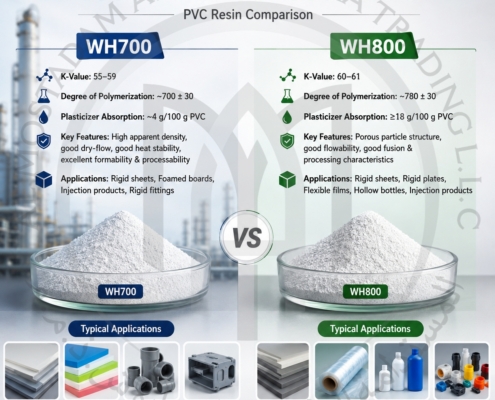
The most important differences between WH700 and WH800 can be seen in their reported K-values and degrees of polymerization.WH700 has a reported K-value of 55–59, while WH800 is listed at approximately 60–61. WH700 also has a reported degree of polymerization of 700 ± 30, compared with approximately 780 ± 30 for WH800.
These differences indicate that WH800 has a somewhat higher molecular characteristic than WH700. In PVC processing, this can influence the way the resin behaves during fusion, melting, compounding, and final product formation.It is important, however, not to oversimplify the comparison.
A higher or lower K-value does not automatically mean that one grade is universally better than another. Each grade is designed around a particular processing window and application profile. A lower-K-value resin may offer advantages in applications where easier processing and rapid fusion are important, while a grade with a somewhat higher K-value may be preferred where a different balance of processability and finished-product performance is required
The application data for the two grades supports this distinction.
WH700 is listed for:
- Rigid calendered sheets
- Foamed boards
- Injection products
- Rigid fittings
WH800 is listed for:
- Rigid calendered sheets
- Rigid plates
- Flexible calendered films
- Hollow blow-molded bottles
- Injection-molded products
The overlap between the two grades is clear. Both can be considered for rigid calendered sheets and injection-molded products. However, the product information also points to areas where each grade may be particularly suitable.
Comparing K-Value and Degree of Polymerization
K-value is one of the most commonly referenced parameters when comparing PVC resin grades. It is associated with the molecular characteristics of the polymer and is often used as a practical reference point during material selection.WH700 has a K-value range of 55–59, while WH800 is reported at 60–61.
The degree of polymerization follows the same general pattern. WH700 is listed at approximately 700 ± 30, whereas WH800 is approximately 780 ± 30.In practical terms, these values suggest that WH700 and WH800 should be evaluated as separate grades rather than simply different names for the same material.For processors, the effect of this difference can be seen in several areas.
First, molecular characteristics can influence the fusion behavior of PVC. The way the particles soften, fuse, and develop into a continuous material is important in processes such as calendering and injection molding.Second, resin characteristics can affect the processing window. A formulation that performs well with one PVC grade may require adjustments when another grade is introduced.
Third, the finished product may respond differently depending on the resin and the rest of the formulation. Mechanical properties, surface quality, processing consistency, and dimensional behavior are influenced by the complete compound.
For this reason, switching from WH700 to WH800, or vice versa, should not be treated as a simple one-to-one replacement without testing.A processor should first review the existing formulation and determine whether changes to stabilizers, lubricants, processing aids, fillers, or other ingredients are necessary.
WH700 vs. WH800: Processing Behavior
Processing behavior is one of the most important factors in selecting a PVC resin.The resin must move through several stages before becoming a finished product. Depending on the manufacturing process, these stages may include storage, conveying, mixing, compounding, heating, fusion, shaping, cooling, and finishing.Any variation in the behavior of the resin can influence production efficiency.
WH700 is described as having good dry-flow characteristics, high apparent density, good heat stability, and excellent formability and processability.Good dry flow is particularly useful during material handling and feeding. In industrial production, consistent powder flow can help maintain stable feeding rates and reduce interruptions caused by irregular material movement.
WH800 is characterized by a porous particle structure together with good flowability and favorable fusion and processing characteristics.The porous structure of WH800 may be particularly relevant in formulations where absorption of liquid additives is important. This can make the grade suitable for applications involving flexible PVC formulations and plasticizer-containing compounds.
The practical difference is that the choice should be based on the actual processing system.For example, a manufacturer producing a rigid foamed board may focus on dry blending behavior, fusion characteristics, cell structure, surface appearance, and dimensional stability. A producer of flexible film will pay greater attention to plasticizer absorption, mixing behavior, calendering performance, and film quality.
The resin should therefore be selected according to the requirements of the process rather than on K-value alone.
Particle Characteristics and Bulk Density
Particle characteristics influence the way a PVC resin behaves as a powder before it enters the processing stage.WH700 and WH800 both have a reported bulk density of at least 0.52 g/ml according to the available product data.Bulk density is important for several practical reasons.
It affects storage and transportation efficiency, powder handling, and feeding into mixers and processing equipment. A stable and consistent bulk density can also contribute to more predictable material movement.However, bulk density is only one part of the picture.Particle size distribution and particle morphology can also influence mixing behavior and additive distribution.
The WH700 technical information reports sieve specifications that include:
- Residue on a 250 μm sieve: ≤1.6%
- Residue on a 63 μm sieve: ≥95%
The WH800 information indicates:
- Residue on a 250 μm sieve: ≤1.6%
- Residue on a 63 μm sieve: ≥97%
Although these values appear close, particle-size specifications should still be reviewed alongside the full product data and actual production requirements.WH800 is also specifically described as having a highly porous particle structure. This is significant because particle porosity can affect the uptake of plasticizers and other liquid components.
For rigid formulations, the importance of particle porosity may differ from that of a highly plasticized compound. A flexible PVC manufacturer, for example, may place greater emphasis on the way the resin absorbs plasticizer during mixing.
Plasticizer Absorption: WH700 vs. WH800
One of the clearest differences in the available technical data relates to plasticizer absorption.WH700 is listed with a plasticizer absorption value of approximately 4 g per 100 g of PVC resin, while WH800 is reported at at least 18 g per 100 g of PVC resin.This is an important distinction when comparing the two grades for flexible PVC applications.
Plasticizers are used to modify the physical behavior of PVC and produce flexible materials. The resin’s ability to absorb plasticizer can affect mixing efficiency and the behavior of the compound before and during processing.WH800’s higher reported plasticizer absorption is consistent with its listed use in flexible calendered films.
This does not mean that plasticizer absorption is the only property that matters in flexible PVC production. The type of plasticizer, formulation design, mixing conditions, temperature, stabilizer system, and processing equipment must all be considered.However, for a processor specifically looking for a PVC resin for flexible calendered film or another plasticized PVC application, this difference may be a major factor in favor of WH800.
WH700, based on its reported technical data and listed applications, appears to be more strongly associated with rigid processing applications.
Applications of WH700 PVC Resin
The WH700 product information identifies several key applications.
Rigid Calendered Sheets
Rigid calendered sheet production requires stable processing and controlled fusion. Surface appearance, thickness consistency, stiffness, and dimensional stability may all be important depending on the final application.
WH700 can be considered for formulations intended for rigid PVC sheet production, particularly where its processing characteristics are compatible with the manufacturer’s equipment and additive package.
Foamed Boards
Foamed PVC boards are specifically listed among the applications for WH700.Foamed PVC processing requires more than simply selecting a base resin. The final product depends on the interaction between the resin, stabilizers, processing aids, blowing agents, fillers, lubricants, and processing conditions.
The grade of PVC can influence fusion behavior and the development of the foamed structure.For manufacturers producing PVC foam boards, WH700 may therefore be evaluated as a base resin according to the requirements of the specific formulation and production line.
Injection Products
WH700 is also listed for injection-molded PVC products.Injection molding requires careful control of material behavior. Temperature, residence time, injection pressure, screw configuration, mold design, and compound stability can all influence the finished product.The resin grade must be compatible with the complete compound and processing conditions.
Rigid Fittings
Rigid fittings are another listed application for WH700.Depending on the product, manufacturers may focus on dimensional accuracy, fusion quality, mechanical performance, surface finish, and long-term consistency.The complete formulation should be developed according to the required product standard and end-use conditions.
Applications of WH800 PVC Resin
WH800 has a somewhat broader listed application profile.
Rigid Calendered Sheets
Like WH700, WH800 can be used for rigid calendered sheet applications.The choice between the two grades should depend on the desired processing conditions and final sheet properties.Manufacturers should compare the actual performance of both materials within their own formulation rather than assuming that one grade will always perform better.
Rigid Plates
WH800 is listed for rigid PVC plate production.Rigid plates can vary considerably in thickness, formulation, mechanical requirements, and end use. The selected resin must work effectively with the chosen stabilizer and lubricant system.Processing trials are particularly useful when changing resin grades.
Flexible Calendered Films
This is one of the applications where WH800 has a notable advantage based on the available product information.Its reported plasticizer absorption and porous particle structure make it suitable for formulations used in flexible PVC film production.Flexible PVC formulations require careful control of plasticizer incorporation and processing behavior. The resin, plasticizer, stabilizer system, and processing conditions must all be matched.
Hollow Blow-Molded Bottles
WH800 is also listed for hollow blow-molded bottles.Blow molding places specific requirements on the PVC compound and the processing line. Melt behavior, formulation stability, equipment conditions, and product design all contribute to the success of the process.
Injection-Molded Products
WH800 can also be used in injection-molded applications.As with WH700, the final result depends on the complete formulation and the conditions of the molding process.
Which Grade Is Better for Rigid PVC Products?
There is no universal answer to this question.Both WH700 and WH800 can be used in rigid PVC applications, including rigid calendered sheets and injection-molded products.The better choice depends on the specific product.
WH700 may be a suitable option for applications specifically identified in its product data, including foamed boards and rigid fittings.WH800 may be considered for rigid plates and other applications where its fusion and processing characteristics provide an advantage.A manufacturer should not choose solely based on the assumption that a higher K-value automatically produces a better rigid product.
The more reliable approach is to compare the two grades under the same production conditions.
This comparison should include:
- Dry blend behavior
- Fusion time
- Processing torque
- Temperature requirements
- Surface appearance
- Production stability
- Dimensional consistency
- Mechanical performance of the finished product
The results of these tests will provide a much clearer basis for selection than a simple comparison of K-values.
Which Grade Is Better for Flexible PVC?
Based on the available product information, WH800 is the more relevant grade for flexible PVC applications.The main reason is its reported plasticizer absorption of at least 18 g per 100 g of PVC resin, compared with the much lower value listed for WH700.
WH800 is also specifically listed for flexible calendered films.For a manufacturer producing plasticized PVC compounds, this does not eliminate the need for formulation testing. Plasticizer type, level, mixing temperature, mixing time, stabilizer system, and other additives can significantly influence the final result.Nevertheless, if the primary application is flexible calendered film, WH800 is more closely aligned with that application according to the available product information.
WH700 vs. WH800 for Injection Molding
Both grades are listed for injection-molded products.The choice between them should depend on the requirements of the molded component.
Factors to consider include:
- Product geometry
- Mold design
- Required cycle time
- Surface quality
- Dimensional tolerance
- Mechanical requirements
- Thermal stability of the formulation
- Existing additive system
WH700’s lower reported K-value may offer a different processing profile from WH800.However, the only reliable way to determine the better option for a particular injection-molding operation is to conduct controlled trials.
A resin substitution can affect processing conditions. Manufacturers may need to adjust temperature profiles, screw conditions, injection settings, or the additive package after changing grades.
WH700 vs. WH800 for Calendering
Both grades are listed for rigid calendered sheets.Calendering requires careful control because the compound must develop the appropriate fusion and rheological behavior before passing through the calender rolls.
Important factors include:
- Fusion behavior
- Temperature profile
- Compound viscosity
- Roll conditions
- Sheet thickness
- Surface quality
- Production speed
WH800’s higher plasticizer absorption makes it more relevant to flexible calendered films as well.WH700, meanwhile, is clearly positioned for rigid calendered sheets.
For a producer manufacturing only rigid sheet, both grades may deserve evaluation. The final decision should be based on actual processing trials and finished-product requirements.
Foamed Boards: Why WH700 May Be the More Relevant Choice
One of the most distinctive listed applications for WH700 is PVC foamed board.Foamed board manufacturing requires a balanced relationship between resin characteristics, formulation design, fusion behavior, blowing system, and processing conditions.The resin must work effectively with the selected processing aids and blowing agents while supporting the formation of a stable and uniform cellular structure.
Because WH700 is specifically identified for foamed board applications, it should be considered a relevant starting point for manufacturers working in this area.That said, the grade alone cannot guarantee product performance.Foam density, cell structure, surface quality, board thickness, stiffness, and dimensional stability depend heavily on the complete formulation and production conditions.A manufacturer changing from one PVC grade to another should validate the material through production trials.
How to Choose Between WH700 and WH800
The first question should be: What product are you manufacturing?If the application is specifically related to PVC foam boards or rigid fittings, WH700 may be the more relevant starting point based on its listed applications.
If the application involves flexible calendered film or requires higher plasticizer absorption, WH800 appears to be the more suitable candidate.For rigid sheets and injection-molded products, both grades may be considered. In these cases, the final decision should be based on actual process performance.The following questions can help guide the selection.
What Is the Processing Method?
Is the material being used for:
- Calendering?
- Injection molding?
- Blow molding?
- Foam board production?
- Rigid fitting production?
The processing method should be the first filter when comparing the grades.
Is the Product Rigid or Flexible?
For flexible PVC formulations, WH800’s higher reported plasticizer absorption makes it particularly relevant.For rigid applications, both grades may be suitable depending on the product.
What Are the Current Processing Conditions?
A resin that performs well in one plant may behave differently in another because of differences in equipment, formulation, and operating conditions.The current temperature profile, mixer, extruder or molding machine, and additive system should all be considered.
Is a Resin Replacement Being Planned?
If a manufacturer is already using one grade and wants to switch to another, a trial is recommended.The new grade may require changes to processing conditions or formulation components.
Important Factors to Consider Before Buying WH700 or WH800
Technical suitability should always come before price alone.A lower purchase price may not represent a real cost advantage if the material causes reduced productivity, inconsistent quality, or additional formulation adjustments.Before purchasing, buyers should consider the following points.
Review the Latest Technical Data Sheet
Specifications can be updated over time. Buyers should request the latest product documentation and confirm the parameters relevant to their application.
Check Batch Consistency
For continuous production, batch-to-batch consistency is important.Certificates of analysis can help buyers compare critical parameters between deliveries.
Evaluate the Supplier
Material availability, technical support, logistics, packaging quality, and consistency of supply are all relevant to industrial production.
Conduct a Production Trial
A trial remains one of the best methods for comparing WH700 and WH800.Ideally, the trial should be performed using the manufacturer’s actual formulation and production equipment.
Compare Total Production Cost
The correct comparison is not limited to the cost per ton.
Manufacturers should also consider:
- Production speed
- Scrap rate
- Energy consumption
- Additive adjustments
- Product quality
- Downtime
- Processing stability
A grade with a higher purchase price may still provide a better overall result if it improves productivity or reduces quality-related losses.
Technical Comparison of WH700 and WH800
The following summary provides a practical comparison based on the available product information.
| Property | WH700 | WH800 |
| PVC Type | Suspension PVC homopolymer | Suspension PVC homopolymer |
| K-Value | 55–59 | 60–61 |
| Degree of Polymerization | Approx. 700 ± 30 | Approx. 780 ± 30 |
| Bulk Density | ≥0.52 g/ml | ≥0.52 g/ml |
| Residue on 250 μm Sieve | ≤1.6% | ≤1.6% |
| Residue on 63 μm Sieve | ≥95% | ≥97% |
| Plasticizer Absorption | Approx. 4 g/100 g PVC | ≥18 g/100 g PVC |
| Whiteness | ≥75 | ≥75 |
| Typical Applications | Rigid sheets, foamed boards, injection products, rigid fittings | Rigid sheets, rigid plates, flexible films, hollow bottles, injection products |
The table is useful as an initial guide, but it should not replace the latest official technical data sheets or production testing.
For manufacturers and buyers, the most effective approach is to compare the technical data, evaluate compatibility with the existing formulation, conduct production trials, and assess the overall production cost rather than focusing only on the purchase price of the resin.
By selecting the PVC grade according to the actual processing requirements, manufacturers can improve production stability, reduce unnecessary adjustments, and achieve more consistent product quality.
Conclusion
WH700 and WH800 are both suspension-polymerized PVC homopolymers, but their technical characteristics and application profiles show important differences.WH700, with its reported K-value of 55–59 and degree of polymerization of approximately 700 ± 30, is associated with rigid PVC applications such as rigid calendered sheets, foamed boards, injection products, and rigid fittings.
WH800, with a K-value of 60–61 and a degree of polymerization of approximately 780 ± 30, has a broader application profile that includes rigid sheets, rigid plates, flexible calendered films, hollow blow-molded bottles, and injection-molded products.The difference in reported plasticizer absorption is also significant. WH800 is the more relevant option when flexible PVC processing and plasticizer incorporation are important considerations.
However, there is no single answer to the question of which grade is “better.” The right choice depends on the application.For foamed boards and rigid fittings, WH700 may be the more appropriate starting point. For flexible calendered films, WH800 appears to be the more suitable option. For rigid sheets and injection-molded products, both grades can be evaluated, with the final decision based on processing trials and product requirements.
 https://almostadamco.com/wp-content/uploads/2026/08/WH700-vs.-WH800-PVC-Resin-Key-Differences-Technical-Comparison-Applications-and-How-to-Choose-the-Right-Grade.jpg
1254
1254
almostadamco
https://almostadamco.com/wp-content/uploads/2025/01/AL-MOSTADAM-LOGO-PNG-290x300.png
almostadamco2026-08-29 20:59:192026-08-29 20:59:22WH700 vs. WH800 PVC Resin: Key Differences, Technical Comparison, Applications, and How to Choose the Right Grade
https://almostadamco.com/wp-content/uploads/2026/08/WH700-vs.-WH800-PVC-Resin-Key-Differences-Technical-Comparison-Applications-and-How-to-Choose-the-Right-Grade.jpg
1254
1254
almostadamco
https://almostadamco.com/wp-content/uploads/2025/01/AL-MOSTADAM-LOGO-PNG-290x300.png
almostadamco2026-08-29 20:59:192026-08-29 20:59:22WH700 vs. WH800 PVC Resin: Key Differences, Technical Comparison, Applications, and How to Choose the Right Grade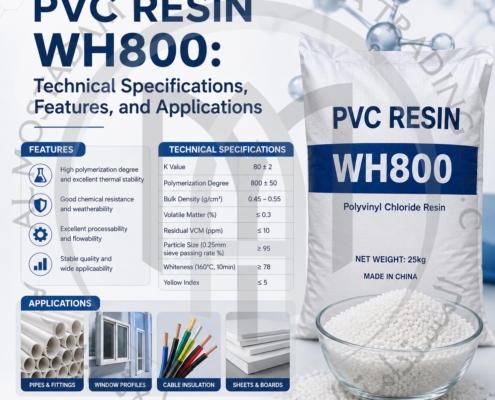 https://almostadamco.com/wp-content/uploads/2026/08/PVC-Resin-WH800-Technical-Specifications-Features-and-Applications.jpg
1254
1254
almostadamco
https://almostadamco.com/wp-content/uploads/2025/01/AL-MOSTADAM-LOGO-PNG-290x300.png
almostadamco2026-08-21 14:06:222026-08-21 14:06:25PVC Resin WH800: Technical Specifications, Features, and Applications
https://almostadamco.com/wp-content/uploads/2026/08/PVC-Resin-WH800-Technical-Specifications-Features-and-Applications.jpg
1254
1254
almostadamco
https://almostadamco.com/wp-content/uploads/2025/01/AL-MOSTADAM-LOGO-PNG-290x300.png
almostadamco2026-08-21 14:06:222026-08-21 14:06:25PVC Resin WH800: Technical Specifications, Features, and Applications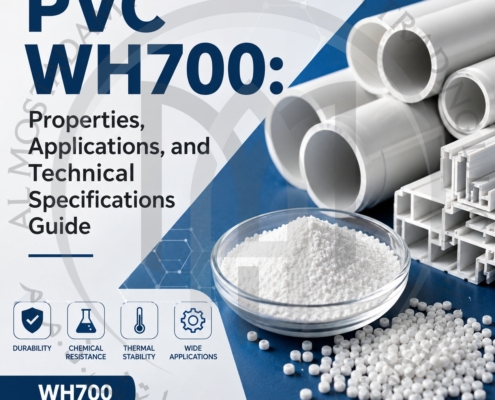 https://almostadamco.com/wp-content/uploads/2026/08/PVC-WH700-Properties-Applications-and-Technical-Specifications-Guide.jpg
1254
1254
almostadamco
https://almostadamco.com/wp-content/uploads/2025/01/AL-MOSTADAM-LOGO-PNG-290x300.png
almostadamco2026-08-09 16:24:402026-08-09 16:24:43PVC WH700: Properties, Applications, and Technical Specifications Guide
https://almostadamco.com/wp-content/uploads/2026/08/PVC-WH700-Properties-Applications-and-Technical-Specifications-Guide.jpg
1254
1254
almostadamco
https://almostadamco.com/wp-content/uploads/2025/01/AL-MOSTADAM-LOGO-PNG-290x300.png
almostadamco2026-08-09 16:24:402026-08-09 16:24:43PVC WH700: Properties, Applications, and Technical Specifications Guide https://almostadamco.com/wp-content/uploads/2026/08/How-to-Buy-PET-PP-and-PE-in-Bulk-Safely-Supplier-Guide-Pricing-Quality-Control.jpg
1254
1254
almostadamco
https://almostadamco.com/wp-content/uploads/2025/01/AL-MOSTADAM-LOGO-PNG-290x300.png
almostadamco2026-08-04 13:18:482026-08-04 13:23:56How to Buy PET, PP and PE in Bulk Safely (Supplier Guide, Pricing & Quality Control)
https://almostadamco.com/wp-content/uploads/2026/08/How-to-Buy-PET-PP-and-PE-in-Bulk-Safely-Supplier-Guide-Pricing-Quality-Control.jpg
1254
1254
almostadamco
https://almostadamco.com/wp-content/uploads/2025/01/AL-MOSTADAM-LOGO-PNG-290x300.png
almostadamco2026-08-04 13:18:482026-08-04 13:23:56How to Buy PET, PP and PE in Bulk Safely (Supplier Guide, Pricing & Quality Control) https://almostadamco.com/wp-content/uploads/2026/08/How-to-Choose-the-Right-HDPE-Grade.jpg
1254
1254
almostadamco
https://almostadamco.com/wp-content/uploads/2025/01/AL-MOSTADAM-LOGO-PNG-290x300.png
almostadamco2026-08-03 13:36:292026-08-03 13:39:30How to Choose the Right HDPE Grade
https://almostadamco.com/wp-content/uploads/2026/08/How-to-Choose-the-Right-HDPE-Grade.jpg
1254
1254
almostadamco
https://almostadamco.com/wp-content/uploads/2025/01/AL-MOSTADAM-LOGO-PNG-290x300.png
almostadamco2026-08-03 13:36:292026-08-03 13:39:30How to Choose the Right HDPE Grade https://almostadamco.com/wp-content/uploads/2026/07/How-Naphtha-Is-Converted-into-Ethylene-and-Propylene.jpg
1254
1254
almostadamco
https://almostadamco.com/wp-content/uploads/2025/01/AL-MOSTADAM-LOGO-PNG-290x300.png
almostadamco2026-07-05 14:33:142026-07-05 14:33:16How Naphtha Is Converted into Ethylene and Propylene
https://almostadamco.com/wp-content/uploads/2026/07/How-Naphtha-Is-Converted-into-Ethylene-and-Propylene.jpg
1254
1254
almostadamco
https://almostadamco.com/wp-content/uploads/2025/01/AL-MOSTADAM-LOGO-PNG-290x300.png
almostadamco2026-07-05 14:33:142026-07-05 14:33:16How Naphtha Is Converted into Ethylene and Propylene https://almostadamco.com/wp-content/uploads/2026/06/How-to-Verify-Polymer-Quality-Before-Purchase.jpg
1254
1254
almostadamco
https://almostadamco.com/wp-content/uploads/2025/01/AL-MOSTADAM-LOGO-PNG-290x300.png
almostadamco2026-06-30 15:54:582026-07-05 14:21:06How to Verify Polymer Quality Before Purchase
https://almostadamco.com/wp-content/uploads/2026/06/How-to-Verify-Polymer-Quality-Before-Purchase.jpg
1254
1254
almostadamco
https://almostadamco.com/wp-content/uploads/2025/01/AL-MOSTADAM-LOGO-PNG-290x300.png
almostadamco2026-06-30 15:54:582026-07-05 14:21:06How to Verify Polymer Quality Before Purchase https://almostadamco.com/wp-content/uploads/2026/06/What-Is-PET-Polyethylene-Terephthalate.jpeg
1254
1254
almostadamco
https://almostadamco.com/wp-content/uploads/2025/01/AL-MOSTADAM-LOGO-PNG-290x300.png
almostadamco2026-06-22 16:39:042026-06-22 17:09:52What Is PET (Polyethylene Terephthalate)?
https://almostadamco.com/wp-content/uploads/2026/06/What-Is-PET-Polyethylene-Terephthalate.jpeg
1254
1254
almostadamco
https://almostadamco.com/wp-content/uploads/2025/01/AL-MOSTADAM-LOGO-PNG-290x300.png
almostadamco2026-06-22 16:39:042026-06-22 17:09:52What Is PET (Polyethylene Terephthalate)? https://almostadamco.com/wp-content/uploads/2026/06/HDPE-vs-PVC-Pipe.jpg
1254
1254
almostadamco
https://almostadamco.com/wp-content/uploads/2025/01/AL-MOSTADAM-LOGO-PNG-290x300.png
almostadamco2026-06-20 15:24:542026-06-28 13:45:21HDPE vs PVC Pipe
https://almostadamco.com/wp-content/uploads/2026/06/HDPE-vs-PVC-Pipe.jpg
1254
1254
almostadamco
https://almostadamco.com/wp-content/uploads/2025/01/AL-MOSTADAM-LOGO-PNG-290x300.png
almostadamco2026-06-20 15:24:542026-06-28 13:45:21HDPE vs PVC Pipe