
PVC is one of the most widely used plastics in the world, and its versatility is one of the main reasons for its popularity. Depending on the formulation and processing method, PVC can be used to manufacture rigid products such as sheets and plates, as well as flexible films and other components.the quality and processing behavior of the PVC resin used in a formulation have a direct effect on the final product. For this reason, choosing the right resin grade is an important part of PVC manufacturing.
WH800 PVC resin is a suspension-polymerized PVC homopolymer developed for a range of processing applications. The grade has a K-value of 60–61 and a degree of polymerization of approximately 780 ± 30. It is characterized by a porous particle structure, good fusion properties, favorable flowability, and good overall processability.according to the manufacturer’s product information, WH800 is commonly used for rigid calendered sheets, rigid plates, flexible calendered films, hollow blow-molded bottles, and injection-molded products.
In this guide, we take a closer look at WH800 PVC resin, its technical properties, typical applications, and the factors that should be considered before using it in production.
What Is PVC Resin WH800?
PVC Resin WH800 is a polyvinyl chloride homopolymer produced through the suspension polymerization process. It is intended to be used as a raw material in PVC formulations rather than as a finished material on its own.in practical terms, PVC resin is usually combined with other ingredients before processing. Depending on the final product, a formulation may contain stabilizers, lubricants, plasticizers, pigments, fillers, impact modifiers, and processing aids. The combination and amount of these additives can vary considerably from one application to another.WH800 has a relatively low degree of polymerization compared with some higher-polymerization PVC grades. The product data specifies a degree of polymerization of 780 ± 30, together with a K-value of 60–61.
The K-value is commonly used in the PVC industry as an indicator of the molecular characteristics of the resin. It is one of the parameters that processors can use when comparing different PVC grades and considering their expected processing behavior.Another characteristic of WH800 is its highly porous particle structure. This feature is relevant to PVC processing because the physical structure of the resin particles can affect the absorption of liquid additives, including plasticizers. Particle morphology can also influence the way the resin behaves during mixing and fusion.
Because WH800 is designed for several processing methods, it can be considered a versatile PVC resin grade. However, the suitability of the material ultimately depends on the formulation, processing equipment, and requirements of the finished product.
Key Features of PVC Resin WH800
Several characteristics distinguish WH800 from other PVC resin grades. These properties are particularly relevant when the resin is being evaluated for industrial production.
Highly Porous Particle Structure
One of the main features listed for WH800 is its highly porous particle structure.Particle morphology is not simply a physical characteristic of the powder. It can affect how efficiently additives are incorporated into the resin during the mixing process. This becomes especially important in formulations that contain plasticizers.
A porous particle structure can help the resin absorb liquid components more effectively, which may contribute to more consistent mixing and processing when the formulation is properly designed.For flexible PVC applications, where relatively large amounts of plasticizer may be used, this characteristic can be particularly useful.
High Apparent Density
The specified bulk density of WH800 is at least 0.52 g/ml.Bulk density is an important consideration when dealing with powdered materials. It affects how the resin behaves during transportation, storage, feeding, and handling.A consistent bulk density can also help maintain stable feeding conditions on production lines. Although bulk density alone does not determine processing performance, it is a useful quality-control parameter when comparing different batches of resin.
Good Melt and Fusion Properties
WH800 is described as having good melt and fusion properties.Fusion is a critical stage in PVC processing. During heating and shearing, PVC particles gradually fuse together and form a continuous material. The quality of this process has an influence on the appearance and physical properties of the final product.
A resin with suitable fusion characteristics can make it easier for processors to achieve consistent results, provided that the formulation and processing conditions are properly matched to the material.
Good Flowability
Powder flow is another practical consideration when working with PVC resin.WH800 is described as having good flowability and processability. Good powder flow can be beneficial during material feeding and mixing, particularly in automated production systems where consistent material delivery is important.Poor powder flow can sometimes lead to irregular feeding, bridging, or variations in the amount of material entering the processing equipment. A resin with favorable flow characteristics can help reduce such issues.
Controlled Quality Parameters
WH800 is also supplied with defined limits for several quality parameters, including volatile matter, sieve residue, fish eyes, whiteness, and residual VCM.Keeping these properties within controlled limits is important for maintaining consistent production quality from one batch to another.
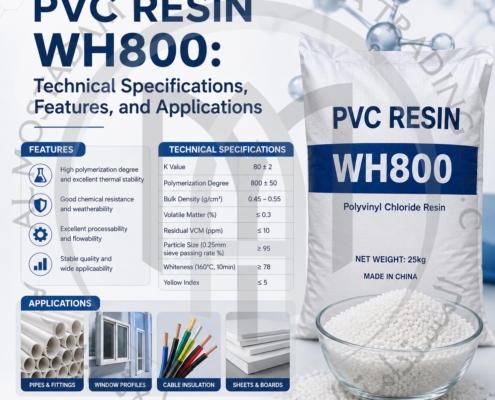
Technical Specifications of PVC Resin WH800
Technical data is one of the first things buyers and processors should review when evaluating a PVC resin. The specifications provide a clearer picture of the material and help determine whether it is appropriate for a particular application.
The main values listed for WH800 are as follows:
| Technical Indicator | Unit | WH800 |
| Degree of Polymerization | — | 780 ± 30 |
| Impurities and Foreign Particles | pcs | ≤ 20 |
| Volatile Matter | % | ≤ 0.3 |
| Bulk Density | g/ml | ≥ 0.52 |
| Residue on 250 μm Sieve | % | ≤ 1.6 |
| Residue on 63 μm Sieve | % | ≥ 97 |
| Fish Eyes | pcs/400 cm² | ≤ 20 |
| Plasticizer Absorption of 100 g PVC Resin | g | ≥ 18 |
| Whiteness | % | ≥ 75 |
| Residual VCM | μg/g | ≤ 1 |
These values are based on the product information shown in the supplied technical sheet. Buyers should always confirm the latest specifications and testing standards directly with the manufacturer or supplier before making a commercial purchase.
Degree of Polymerization
WH800 has a degree of polymerization of 780 ± 30.
This value provides information about the polymer chains and is useful when comparing PVC resin grades. Different degrees of polymerization can result in differences in processing behavior and the properties that can be achieved in the finished product.
K-Value
The stated K-value for WH800 is 60–61.
In PVC applications, K-value is commonly considered when selecting a resin for a particular processing requirement. It is related to the molecular characteristics of the polymer and can be useful when comparing grades from different suppliers.
Volatile Matter
The maximum specified volatile matter is 0.3%.
Keeping volatile matter under control is important for material quality and consistent processing. The actual significance of this parameter can vary depending on the application and processing conditions.
Bulk Density
The bulk density is specified at ≥ 0.52 g/ml.
For manufacturers, this figure is relevant to powder handling and feeding. It can also be useful for warehouse planning and transportation calculations.
Particle Size
The product sheet lists a maximum residue of 1.6% on a 250 μm sieve and at least 97% residue on a 63 μm sieve.Particle-size distribution can influence mixing behavior, additive absorption, and the overall handling characteristics of the resin.
Fish Eyes
The specification for fish eyes is ≤ 20 pcs/400 cm².
Fish eyes are undesirable defects that may become visible in processed PVC products. This parameter can be particularly important in applications where a smooth and uniform surface is required.
Plasticizer Absorption
WH800 has a plasticizer absorption value of at least 18 g per 100 g of PVC resin.This characteristic is especially relevant to flexible PVC formulations. The ability of the resin to absorb plasticizer can affect the mixing process and the consistency of the resulting compound.
Whiteness
The specified whiteness is ≥ 75%.
Whiteness is an important quality characteristic for products where the appearance of the base material matters or where the resin is used in light-colored formulations.
Residual VCM
The residual vinyl chloride monomer (VCM) value is specified at ≤ 1 μg/g.Residual VCM is an important quality and regulatory parameter for PVC resin. Requirements can vary depending on the intended application and the regulations applicable in the target market.
Applications of PVC Resin WH800
WH800 can be used in several PVC manufacturing processes. The manufacturer’s product information lists five main application areas: rigid calendered sheets, rigid plates, flexible calendered films, hollow blow-molded bottles, and injection-molded products.
Rigid Calendered Sheets
Calendering is widely used to manufacture PVC sheets and films. In this process, the PVC compound passes through a series of heated rolls, where it is formed into a continuous sheet with a controlled thickness.For rigid sheet production, WH800 can be incorporated into formulations designed to provide the required stiffness, surface quality, and processing behavior.The exact formulation will depend on the thickness, appearance, mechanical properties, and end-use requirements of the sheet.
Rigid PVC Plates
Rigid PVC plates are used in a variety of industrial and commercial applications.When WH800 is used for rigid plate production, the resin is typically combined with stabilizers, lubricants, and other additives selected according to the processing method and required product properties.The final characteristics of the plate will depend on the complete formulation rather than the resin grade alone.
Flexible Calendered Films
PVC can be made flexible through the use of plasticizers. Flexible PVC films are produced for applications where flexibility, surface quality, and controlled thickness are required.WH800’s plasticizer absorption characteristics make it suitable for formulations in which plasticizers are an important part of the compound.As with any flexible PVC application, the type and level of plasticizer, together with stabilizers and processing aids, need to be selected carefully.
Hollow Blow-Molded Bottles
The product sheet also lists hollow blow-molded bottles among the typical applications of WH800.Blow molding requires a resin and formulation that can provide appropriate melt behavior during the formation of the parison and subsequent molding operation.The actual processing window will depend on the equipment, formulation, mold design, and product specifications.
Injection-Molded Products
WH800 can also be used in injection-molding applications.Injection molding is commonly used for producing PVC components with specific dimensions and shapes. Successful processing depends on several factors, including resin characteristics, formulation, temperature profile, screw conditions, injection pressure, mold design, and residence time.For this reason, processors should evaluate the complete compound rather than relying on the PVC resin specification alone.
Advantages of Using PVC WH800
WH800 offers a combination of properties that can be useful for manufacturers looking for a versatile PVC resin.
Versatile Processing Options
One of the practical advantages of this grade is the range of applications listed by the manufacturer. WH800 can be considered for calendering, blow molding, and injection molding applications.This can be useful for manufacturers working with several types of PVC products or looking for a resin that can be incorporated into different formulations.
Good Processability
The combination of good flowability and fusion characteristics can contribute to stable processing when the resin is used under appropriate conditions.For large-scale manufacturing, consistent processing behavior can have a direct effect on production efficiency and product quality.
Useful Plasticizer Absorption
The specified plasticizer absorption of ≥18 g/100 g resin is an important characteristic for flexible PVC applications.Good plasticizer absorption can make the compounding process more predictable and help achieve a more uniform distribution of plasticizer throughout the PVC compound.
Controlled Particle Characteristics
The particle-size specifications provide processors with a defined range for the physical characteristics of the resin.Consistent particle properties can help with powder handling, mixing, and processing.
Suitable for Different Product Types
WH800 is not limited to one particular PVC product. It can be considered for both rigid and flexible formulations, depending on the formulation design and processing method.
This makes the grade relevant to manufacturers producing sheets, plates, films, bottles, and molded components.
What Products Is PVC Resin WH800 Suitable For?
The answer depends on the formulation and production process, but the manufacturer’s technical information identifies several typical applications for WH800.
These include:
- Rigid PVC calendered sheets
- Rigid PVC plates
- Flexible PVC calendered films
- Hollow blow-molded bottles
- Injection-molded PVC products
For rigid PVC products, manufacturers may focus on stiffness, dimensional stability, surface appearance, fusion behavior, and processing consistency.
For flexible films, plasticizer absorption and the compatibility of the resin with the selected plasticizer system become more important.
For blow-molded products, melt strength, processing stability, formulation design, and equipment conditions need to be considered together.
Injection-molded products require attention to the complete processing cycle, including temperature, pressure, mold design, and the thermal stability of the formulation.
In other words, WH800 can be a suitable starting resin for several product categories, but the final formulation should always be developed around the specific requirements of the finished product.
Important Considerations When Buying PVC Resin WH800
Buying PVC resin for industrial use involves more than checking the price per ton. The material needs to be evaluated against the actual production requirements.
Check the Latest Technical Data Sheet
Before purchasing, buyers should request the latest technical data sheet and verify the main specifications.Particular attention should be given to K-value, degree of polymerization, bulk density, particle-size distribution, plasticizer absorption, whiteness, fish eyes, volatile matter, and residual VCM.
Make Sure the Grade Matches the Application
The intended application should be discussed with the supplier before ordering.a resin grade suitable for a particular calendering application may not necessarily deliver the same results in another process. Confirming the intended use helps reduce the risk of selecting an unsuitable grade.
Consider the Complete Formulation
PVC resin is only one part of the final compound.Stabilizers, lubricants, plasticizers, fillers, pigments, impact modifiers, and processing aids can all influence the behavior of the finished material.For this reason, processors should evaluate WH800 together with their actual formulation rather than testing the resin in isolation.
Check Batch-to-Batch Consistency
Consistency is particularly important for manufacturers running continuous production.When purchasing larger quantities, it is useful to review certificates of analysis and compare important properties between batches.
Review Packaging and Storage Conditions
PVC resin should be stored and handled according to the supplier’s recommendations. Packaging should protect the powder from contamination and other conditions that could affect material quality.Good warehouse practices are particularly important when the resin will be stored for an extended period.
Ask for Relevant Documentation
Depending on the market and application, buyers may require documents such as a technical data sheet, Safety Data Sheet (SDS), Certificate of Analysis (COA), packaging specifications, and other compliance documents.
For regulated applications, additional documentation may be required.
Test Before Full-Scale Production
Even if the technical specifications appear to match the requirements, it is good practice to conduct trials before switching to a new resin grade.Laboratory or pilot-scale testing can help determine how WH800 behaves with the manufacturer’s existing additives and processing conditions.This is particularly important when the resin will be used in a formulation that has already been optimized around another PVC grade.
Conclusion
PVC Resin WH800 is a suspension-polymerized PVC homopolymer designed for a range of industrial processing applications. With a K-value of 60–61, a degree of polymerization of 780 ± 30, a porous particle structure, and good flow and fusion characteristics, the grade offers a useful combination of properties for PVC processors.
According to the supplied technical information, WH800 is commonly used in rigid calendered sheets, rigid PVC plates, flexible calendered films, hollow blow-molded bottles, and injection-molded products.
Its specified bulk density, particle-size characteristics, plasticizer absorption, whiteness, and residual VCM level are additional parameters that manufacturers can consider when evaluating the grade.
Still, selecting a PVC resin should never be based on a single specification. The right choice depends on the final product, formulation, processing equipment, production conditions, and quality requirements.
For buyers, the best approach is to review the complete technical data, discuss the intended application with the supplier, test the resin with the actual formulation, and confirm batch consistency before moving to large-scale production.
When these factors are properly evaluated, WH800 can be a practical option for manufacturers looking for a PVC resin suitable for both rigid and flexible processing applications
 https://almostadamco.com/wp-content/uploads/2026/08/PVC-Resin-WH800-Technical-Specifications-Features-and-Applications.jpg
1254
1254
almostadamco
https://almostadamco.com/wp-content/uploads/2025/01/AL-MOSTADAM-LOGO-PNG-290x300.png
almostadamco2026-08-21 14:06:222026-08-21 14:06:25PVC Resin WH800: Technical Specifications, Features, and Applications
https://almostadamco.com/wp-content/uploads/2026/08/PVC-Resin-WH800-Technical-Specifications-Features-and-Applications.jpg
1254
1254
almostadamco
https://almostadamco.com/wp-content/uploads/2025/01/AL-MOSTADAM-LOGO-PNG-290x300.png
almostadamco2026-08-21 14:06:222026-08-21 14:06:25PVC Resin WH800: Technical Specifications, Features, and Applications https://almostadamco.com/wp-content/uploads/2026/08/PVC-WH700-Properties-Applications-and-Technical-Specifications-Guide.jpg
1254
1254
almostadamco
https://almostadamco.com/wp-content/uploads/2025/01/AL-MOSTADAM-LOGO-PNG-290x300.png
almostadamco2026-08-09 16:24:402026-08-09 16:24:43PVC WH700: Properties, Applications, and Technical Specifications Guide
https://almostadamco.com/wp-content/uploads/2026/08/PVC-WH700-Properties-Applications-and-Technical-Specifications-Guide.jpg
1254
1254
almostadamco
https://almostadamco.com/wp-content/uploads/2025/01/AL-MOSTADAM-LOGO-PNG-290x300.png
almostadamco2026-08-09 16:24:402026-08-09 16:24:43PVC WH700: Properties, Applications, and Technical Specifications Guide https://almostadamco.com/wp-content/uploads/2026/08/How-to-Buy-PET-PP-and-PE-in-Bulk-Safely-Supplier-Guide-Pricing-Quality-Control.jpg
1254
1254
almostadamco
https://almostadamco.com/wp-content/uploads/2025/01/AL-MOSTADAM-LOGO-PNG-290x300.png
almostadamco2026-08-04 13:18:482026-08-04 13:23:56How to Buy PET, PP and PE in Bulk Safely (Supplier Guide, Pricing & Quality Control)
https://almostadamco.com/wp-content/uploads/2026/08/How-to-Buy-PET-PP-and-PE-in-Bulk-Safely-Supplier-Guide-Pricing-Quality-Control.jpg
1254
1254
almostadamco
https://almostadamco.com/wp-content/uploads/2025/01/AL-MOSTADAM-LOGO-PNG-290x300.png
almostadamco2026-08-04 13:18:482026-08-04 13:23:56How to Buy PET, PP and PE in Bulk Safely (Supplier Guide, Pricing & Quality Control) https://almostadamco.com/wp-content/uploads/2026/08/How-to-Choose-the-Right-HDPE-Grade.jpg
1254
1254
almostadamco
https://almostadamco.com/wp-content/uploads/2025/01/AL-MOSTADAM-LOGO-PNG-290x300.png
almostadamco2026-08-03 13:36:292026-08-03 13:39:30How to Choose the Right HDPE Grade
https://almostadamco.com/wp-content/uploads/2026/08/How-to-Choose-the-Right-HDPE-Grade.jpg
1254
1254
almostadamco
https://almostadamco.com/wp-content/uploads/2025/01/AL-MOSTADAM-LOGO-PNG-290x300.png
almostadamco2026-08-03 13:36:292026-08-03 13:39:30How to Choose the Right HDPE Grade https://almostadamco.com/wp-content/uploads/2026/07/How-Naphtha-Is-Converted-into-Ethylene-and-Propylene.jpg
1254
1254
almostadamco
https://almostadamco.com/wp-content/uploads/2025/01/AL-MOSTADAM-LOGO-PNG-290x300.png
almostadamco2026-07-05 14:33:142026-07-05 14:33:16How Naphtha Is Converted into Ethylene and Propylene
https://almostadamco.com/wp-content/uploads/2026/07/How-Naphtha-Is-Converted-into-Ethylene-and-Propylene.jpg
1254
1254
almostadamco
https://almostadamco.com/wp-content/uploads/2025/01/AL-MOSTADAM-LOGO-PNG-290x300.png
almostadamco2026-07-05 14:33:142026-07-05 14:33:16How Naphtha Is Converted into Ethylene and Propylene https://almostadamco.com/wp-content/uploads/2026/06/How-to-Verify-Polymer-Quality-Before-Purchase.jpg
1254
1254
almostadamco
https://almostadamco.com/wp-content/uploads/2025/01/AL-MOSTADAM-LOGO-PNG-290x300.png
almostadamco2026-06-30 15:54:582026-07-05 14:21:06How to Verify Polymer Quality Before Purchase
https://almostadamco.com/wp-content/uploads/2026/06/How-to-Verify-Polymer-Quality-Before-Purchase.jpg
1254
1254
almostadamco
https://almostadamco.com/wp-content/uploads/2025/01/AL-MOSTADAM-LOGO-PNG-290x300.png
almostadamco2026-06-30 15:54:582026-07-05 14:21:06How to Verify Polymer Quality Before Purchase https://almostadamco.com/wp-content/uploads/2026/06/What-Is-PET-Polyethylene-Terephthalate.jpeg
1254
1254
almostadamco
https://almostadamco.com/wp-content/uploads/2025/01/AL-MOSTADAM-LOGO-PNG-290x300.png
almostadamco2026-06-22 16:39:042026-06-22 17:09:52What Is PET (Polyethylene Terephthalate)?
https://almostadamco.com/wp-content/uploads/2026/06/What-Is-PET-Polyethylene-Terephthalate.jpeg
1254
1254
almostadamco
https://almostadamco.com/wp-content/uploads/2025/01/AL-MOSTADAM-LOGO-PNG-290x300.png
almostadamco2026-06-22 16:39:042026-06-22 17:09:52What Is PET (Polyethylene Terephthalate)? https://almostadamco.com/wp-content/uploads/2026/06/HDPE-vs-PVC-Pipe.jpg
1254
1254
almostadamco
https://almostadamco.com/wp-content/uploads/2025/01/AL-MOSTADAM-LOGO-PNG-290x300.png
almostadamco2026-06-20 15:24:542026-06-28 13:45:21HDPE vs PVC Pipe
https://almostadamco.com/wp-content/uploads/2026/06/HDPE-vs-PVC-Pipe.jpg
1254
1254
almostadamco
https://almostadamco.com/wp-content/uploads/2025/01/AL-MOSTADAM-LOGO-PNG-290x300.png
almostadamco2026-06-20 15:24:542026-06-28 13:45:21HDPE vs PVC Pipe https://almostadamco.com/wp-content/uploads/2026/06/Chemical-Resistance-of-Common-Industrial-Plastics.jpeg
1254
1254
almostadamco
https://almostadamco.com/wp-content/uploads/2025/01/AL-MOSTADAM-LOGO-PNG-290x300.png
almostadamco2026-06-20 13:08:232026-06-20 13:08:25Chemical Resistance of Common Industrial Plastics
https://almostadamco.com/wp-content/uploads/2026/06/Chemical-Resistance-of-Common-Industrial-Plastics.jpeg
1254
1254
almostadamco
https://almostadamco.com/wp-content/uploads/2025/01/AL-MOSTADAM-LOGO-PNG-290x300.png
almostadamco2026-06-20 13:08:232026-06-20 13:08:25Chemical Resistance of Common Industrial Plastics